The Solar Pantry
Turning Sunshine Into Food Security

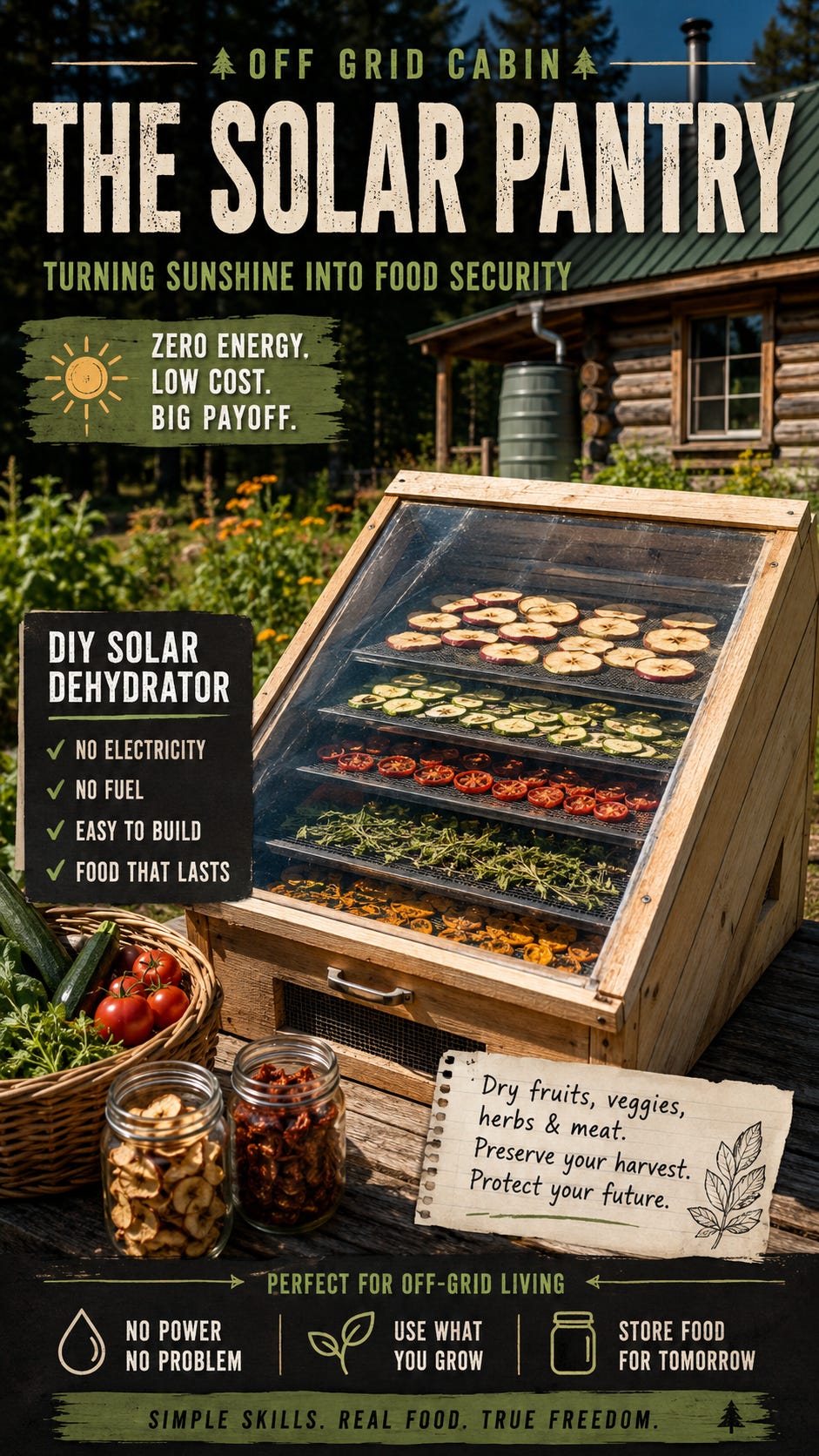
The £100 Food Security Challenge
A curious thing happens when food prices climb.
People start paying attention to things their grandparents considered perfectly normal.
For years, the idea of preserving food felt almost quaint. Supermarkets were open seven days a week. Fresh produce appeared regardless of season. If you wanted strawberries in December, someone, somewhere, would make sure they arrived on a shelf near you.
Yet the past few years have reminded many of us that convenience is not the same thing as resilience.
A garden full of vegetables is wonderful. A fruit tree heavy with produce is even better. But abundance brings its own challenge. What do you do when everything ripens at once?
One answer arrives from a technology so simple that it barely feels like technology at all.
Sunlight.
Not solar panels. Not batteries. Not inverters.
Just sunlight.
The humble solar food dehydrator may be one of the most overlooked tools in the self-reliance toolbox. It requires no electricity, no fuel, and very little maintenance. Yet it can transform a temporary harvest into food that lasts for months.
In an age obsessed with smart devices, apps, subscriptions, and endless upgrades, there is something refreshingly honest about a wooden box that quietly turns excess food into stored nutrition.
The Forgotten Art of Preservation
For most of human history, food preservation was not a hobby.
It was survival.
Communities dried fruit, herbs, vegetables, and meat because they understood a simple truth. The harvest season is temporary. Winter eventually arrives.
Modern life largely removed that lesson from daily experience. We became accustomed to year-round availability. Supply chains stretched across continents. Refrigeration became universal.
Yet every gardener eventually encounters the same dilemma.
One week there are three courgettes.
The next week there are thirty.
Tomatoes suddenly appear faster than they can be eaten. Herbs begin taking over entire sections of the garden. Fruit trees decide that now, today, is the moment every piece of fruit should ripen simultaneously.
A solar dehydrator turns that problem into an opportunity.
Instead of watching surplus food spoil, you preserve it.
The result is food that occupies a fraction of the storage space while retaining much of its flavour and nutritional value.
Building A Solar Dehydrator
One of the reasons this project appeals to off-grid thinkers is its simplicity.
Most versions can be built over a weekend using basic woodworking skills and readily available materials.
At its heart, a solar dehydrator is simply a solar collector combined with good airflow.
The basic design consists of:
A wooden frame
A sloping transparent lid made from glass or polycarbonate
Black drying trays or mesh screens
Air intake vents near the bottom
Exhaust vents near the top
Sunlight enters through the clear cover and heats the interior. Warm air rises naturally, pulling moisture away from the food and out through the vents.
Nature does most of the work.
No plugs required.
Many builders use reclaimed timber, salvaged windows, leftover hardware cloth, or surplus materials from previous projects. As a result, costs can remain surprisingly low.
Some enthusiasts add small solar-powered fans to increase airflow, but many systems function perfectly well without them.
The beauty lies in the simplicity.
Less to break often means more reliability.
Why It Matters In 2026
Food preservation is no longer just about nostalgia.
Increasingly, it is becoming a practical response to economic reality.
Food costs remain a concern for many households. Supply disruptions still occur. Extreme weather continues to affect harvests around the world.
Against that backdrop, preserving your own food begins to look less like a hobby and more like sensible preparation.
A shelf filled with jars and dehydrated produce represents something increasingly valuable.
Options.
A bag of dried apples becomes a winter snack.
Dried herbs become flavour when supermarket prices rise.
Home-made vegetable powders become ingredients for soups, stews, and sauces.
None of this is revolutionary.
That is precisely why it works.
The Community Experiment
One aspect that makes a solar dehydrator especially suitable for an off-grid community is that no two versions are exactly alike.
One member might build a compact model suitable for a balcony garden.
Another might create a large-capacity unit capable of processing entire harvests.
Someone else might experiment with different vent designs, insulation methods, or tray arrangements.
The knowledge grows through experimentation.
One person discovers that mint dries beautifully.
Another perfects dried tomato slices.
Someone else develops a method for preserving chillies or creating herb blends.
Before long, the dehydrator is no longer just a project.
It becomes a conversation.
That may be the most valuable output of all.
The Bigger Lesson
The solar dehydrator is not really about dried food.
Not entirely.
It represents a way of thinking.
A willingness to use what is available rather than constantly purchasing what is convenient.
A habit of solving problems before they become emergencies.
A recognition that resilience is often built from dozens of small decisions rather than one dramatic action.
The off-grid journey is rarely about escaping civilisation.
It is about reducing dependency.
Every skill learned. Every system built. Every resource conserved.
These things add up.
A solar dehydrator may seem like a small project.
Yet somewhere between the drying apples, preserved herbs, and jars of stored produce sits a larger reward.
The quiet confidence that comes from knowing you can provide a little more for yourself than you could yesterday.
And in uncertain times, that might be one of the most valuable harvests of all.
💌 Until Next Time
From my cabin to yours, may your shelves be full, your jars lined with colour, and your heart warmed by the knowledge that you’re walking in the footsteps of generations who knew the value of saving for the season ahead.
So, what are your thoughts?
Until Next Time


Message Dominus Owen Markham
PLEASE SHARE THIS NEWSLETTER FAR AND WIDE,
I intend to keep the subscription fully FREE for as long as possible!
Join me as a supporter and member with a real-life couple off-grid in Sweden:

Some of my other newsletters: