

Quiet Competence
The Value of Capability in an Age of Performance

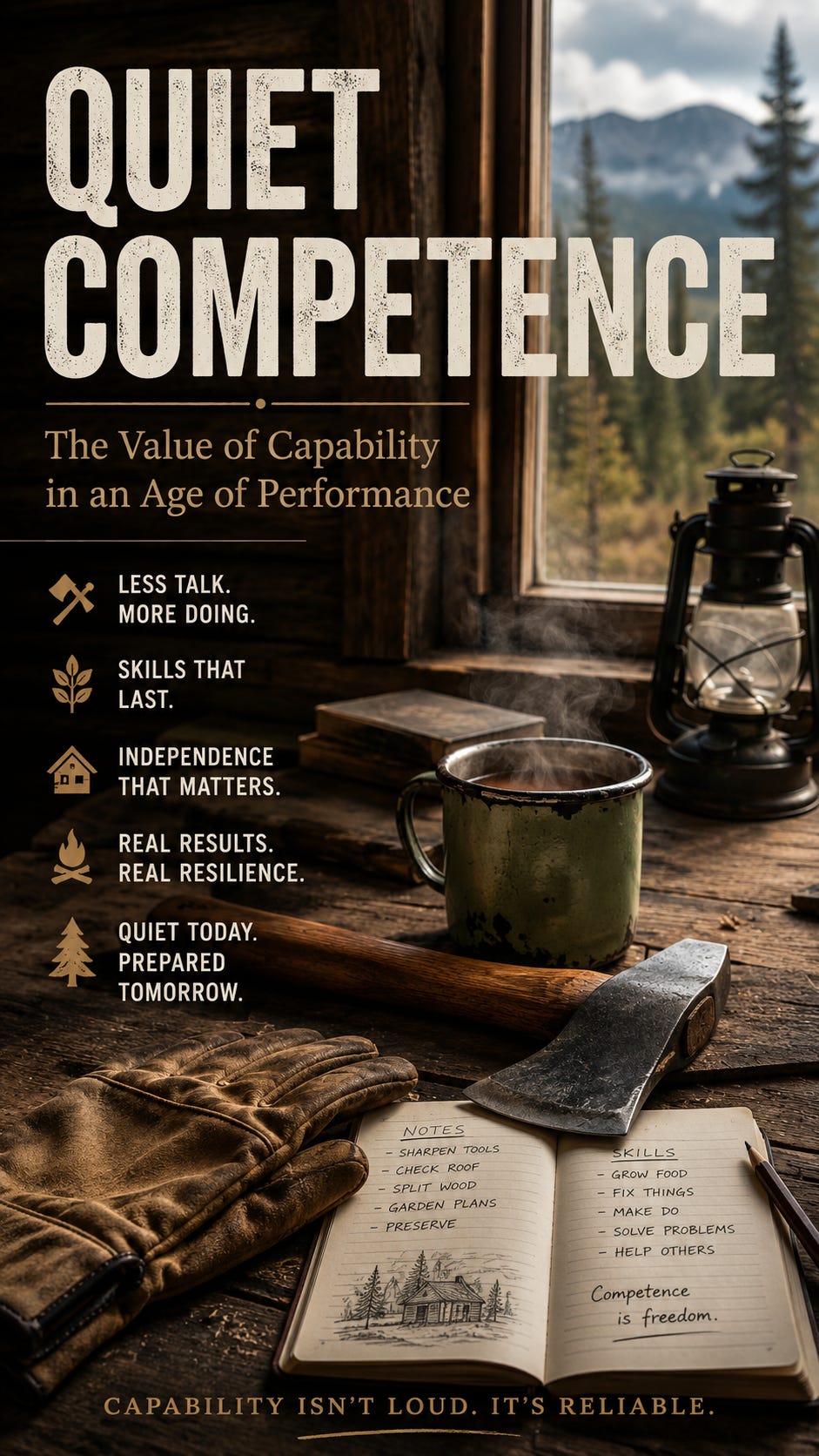
A peculiar shift has taken place during the past couple of decades.
Many of the qualities that once quietly earned respect have been replaced by qualities that attract attention. Visibility has become a currency in its own right. The ability to present, promote, and project often receives more recognition than the ability to actually do. In some corners of modern life, appearance and reality have drifted so far apart that they occasionally seem to occupy entirely different worlds.
This is not necessarily anyone’s fault. Technology has changed the environment in which we live. Social media platforms reward visibility because visibility keeps people engaged. Algorithms naturally elevate what can be seen, measured, shared, and amplified. The result is a culture where almost every activity can become a performance if given the opportunity.
A walk through the countryside becomes content. A meal becomes content. A project becomes content. Even the process of learning a skill increasingly risks becoming content.
None of this is inherently bad. Sharing knowledge can be useful. Inspiration can motivate others to begin their own journeys. Communities can form around common interests and practical skills. Yet somewhere along the way a subtle distinction has become blurred.
The distinction between looking capable and being capable.
For most of human history, competence was not something people advertised. It was simply demonstrated through outcomes. The neighbour who could repair machinery was known because machinery kept working. The carpenter was respected because buildings remained standing. The gardener earned a reputation because vegetables appeared year after year despite difficult weather and poor seasons.
There were no personal brands. There were no curated feeds. There was simply evidence.
The warm house.
The productive garden.
The repaired fence.
The full woodshed.
The stocked pantry.
Results spoke for themselves.
Today, however, we inhabit a world where signals are often easier to notice than substance. A person can spend thousands on survival equipment without ever spending a night outdoors. A garage can be filled with tools that have never touched a piece of timber. A bookshelf can be filled with manuals that have never been opened. Entire identities can be assembled through purchases rather than experience.
The irony is that genuine competence rarely looks particularly impressive from the outside.
The experienced gardener does not usually spend much time discussing gardening. They are too busy gardening.
The skilled mechanic is often found quietly diagnosing problems rather than talking about mechanical theory.
The capable cook rarely needs to explain their expertise. The meal itself does the talking.
Real skill often appears deceptively ordinary because it has become integrated into daily life. The person performing the task no longer thinks of it as remarkable. It is simply something they know how to do.
That ordinariness can make competence surprisingly difficult to recognise in an age that rewards spectacle.
Modern culture tends to favour dramatic moments. The reveal. The announcement. The transformation. The breakthrough. Yet almost every meaningful skill develops through repetition rather than drama. The visible result is usually the least interesting part of the story. What matters is the long period beforehand, when nobody is watching.
A stack of neatly split firewood is satisfying to look at, but the real value lies in the hours spent learning how to use an axe efficiently and safely. A thriving vegetable garden is pleasing to photograph, but the harvest itself represents months of observation, mistakes, adjustments, and persistence. A well-run household often appears effortless from the outside precisely because so much quiet effort has already gone into making it function smoothly.
Competence is rarely built in moments of excitement.
It is built in moments of repetition.
That truth sits at the heart of many off-grid and self-reliance projects. The reality of living more independently is often far less glamorous than people imagine. It involves maintenance, preparation, routine, and patience. There are no shortcuts around these things. Solar panels eventually require attention. Water systems need checking. Gardens need tending. Firewood needs processing. Equipment wears out and requires repair.
The romantic image of self-reliance is easy to sell.
The daily practice of self-reliance is considerably less photogenic.
Yet this is precisely where quiet competence begins to reveal its value. The person who learns practical skills is not simply acquiring knowledge. They are acquiring options. Every skill creates a degree of freedom. Every capability reduces dependency. Every problem solved personally is one less problem requiring outside intervention.
That freedom is difficult to quantify, which may be why it receives less attention than more visible forms of success.
A person who knows how to grow food possesses a different relationship with uncertainty than someone who does not. The same can be said for those who know how to repair household items, preserve food, navigate without technology, cook from basic ingredients, manage resources carefully, or improvise solutions when circumstances change unexpectedly.
None of these skills guarantee security.
They do, however, expand the range of available responses.
In uncertain times, that matters.
One of the most striking characteristics of genuinely competent people is the calmness they often display when confronted with problems. This is not because they possess special courage or unusual confidence. More often, it is because experience has shown them that many difficulties can be solved through patient action.
The first time a person encounters a major challenge, panic is understandable.
The tenth time often produces a different reaction.
Experience creates perspective.
The person who has repaired dozens of things approaches breakdowns differently. The person who has navigated previous disruptions tends to react differently when new ones emerge. The individual who has spent years solving practical problems develops a habit of looking for solutions rather than catastrophes.
This calmness is one of the hidden rewards of competence.
It is not merely about knowing how to perform a task. It is about developing confidence in one’s ability to respond when circumstances become difficult.
Perhaps that is why older generations often appeared less rattled by events than we sometimes seem today. Many grew up in environments where practical capability was a necessity rather than an optional hobby. They learned to mend because replacement was expensive. They learned to preserve food because waste was unacceptable. They learned to adapt because circumstances demanded it.
Necessity became education.
The lessons remained long after the necessity disappeared.
Modern life has undoubtedly delivered remarkable conveniences. Few people would willingly abandon modern healthcare, communications, or countless other advances that improve quality of life. Yet convenience can sometimes obscure an uncomfortable reality.
A system that performs every task for us gradually reduces the number of tasks we can perform ourselves.
This is not an argument against technology. It is simply an observation. Every tool changes the relationship between people and capability. Calculators reduce mental arithmetic. GPS reduces navigation skills. Online shopping reduces knowledge of local suppliers. Artificial intelligence may eventually reduce other forms of effort as well.
The challenge is not whether these tools exist.
The challenge is deciding which capabilities remain worth preserving.
That question feels increasingly important.
A society that forgets how things work becomes dependent upon those who still remember. Individuals who lose practical competence become vulnerable to systems they no longer understand. The more complex modern life becomes, the more valuable basic capability may become as a form of resilience.
Perhaps that is why quiet competence feels almost rebellious today.
It rejects the idea that appearance is enough.
It values substance over presentation.
It accepts that mastery takes time.
It embraces the unfashionable truth that some things can only be learned through experience.
Most importantly, it understands that reality ultimately conducts its own examinations. The world cares very little about image when genuine problems arise. A storm does not care about personal branding. A power cut does not care about follower counts. Broken machinery remains stubbornly indifferent to online reputation.
Reality has always possessed a habit of exposing the difference between performance and capability.
When circumstances become challenging, competence suddenly becomes visible again.
The person who can solve the problem becomes the person everyone looks towards.
Not because they demanded attention.
Because they earned trust.
That trust may be one of the most valuable forms of wealth a person can possess. It cannot be purchased instantly, downloaded, outsourced, or manufactured through clever marketing. It emerges slowly through reliability, consistency, and demonstrated ability.
Like most worthwhile things, it accumulates over time.
The older I get, the more I admire people who possess this quality. The neighbour who quietly helps others without seeking recognition. The tradesman whose work speaks for itself. The gardener who consistently produces harvests year after year. The mechanic who diagnoses problems by ear. The cook who can create a meal from almost nothing. They rarely describe themselves as exceptional.
They simply know what they are doing.
And perhaps that is the essence of quiet competence.
Not expertise as performance.
Not knowledge as status.
Not skill as identity.
Simply the steady development of capability, pursued because it is useful rather than because it is visible.
The world will probably continue rewarding performance. There is little sign of that changing. Yet beneath the noise, the value of competence remains remarkably constant. A sharpened axe still cuts. A repaired fence still stands. A productive garden still feeds people. A useful skill remains useful whether anyone applauds it or not.
In the end, quiet competence offers something that trends and fashions cannot.
It offers confidence rooted in reality.
And that may be one of the most valuable forms of resilience we can cultivate.
💌 Until Next Time
From my cabin to yours, may your shelves be full, your jars lined with colour, and your heart warmed by the knowledge that you’re walking in the footsteps of generations who knew the value of saving for the season ahead.
So, what are your thoughts?
Until Next Time


Message Dominus Owen Markham
PLEASE SHARE THIS NEWSLETTER FAR AND WIDE,
I intend to keep the subscription fully FREE for as long as possible!
Join me as a supporter and member with a real-life couple off-grid in Sweden:

Some of my other newsletters:





Performance artists are also great at showing the final product, but not so much at showing all the hard work behind it, which can lead the beginner into a false sense of thinking that something is easy.